TL;DR
- Salvias combine best with plants that share their love of sun and free-draining soil
- Ornamental grasses are the single best companion — they provide movement, contrast and extend the season
- Echinacea, verbena bonariensis and agapanthus all work beautifully alongside salvias in summer borders
- Spring bulbs planted beneath salvias fill the gap before salvias get going in late spring
- Avoid pairing salvias with moisture-lovers like hostas, astilbes or bog plants — the growing conditions simply don’t match
Introduction
A salvia planted on its own is impressive. A salvia planted well is unforgettable. The difference is almost always about what’s growing around it — the plants that frame it, support it visually, and fill the gaps when salvias aren’t at their peak.
Good salvia companion planting isn’t about following rules. It’s about understanding what a plant needs and what it offers, then finding neighbours that complement both. For salvias, that means sun-loving, reasonably drought-tolerant partners that work with the salvia’s upright flower spikes rather than competing with them.
At Middleton Nurseries we’ve been pairing salvias with other plants for decades. These are the combinations we keep coming back to. and here are the best Salvia’s for pots.
Quick Facts
| Salvia’s growing conditions | Full sun, free-draining soil, relatively low moisture |
| Flowering season | Varies — nemorosa early summer, microphylla late spring to frost |
| Height range | 30cm (compact nemorosa) to 150cm+ (guaranitica) |
| Key design role | Upright flower spikes — best paired with contrasting forms |
| What to avoid | Moisture-loving plants, heavy shade-casters, aggressive spreaders |
Ornamental Grasses — The Perfect Partner
Works with every salvia in every situation
Grasses and salvias share almost identical growing preferences, so they thrive together without competing for resources. Visually, grasses provide exactly what salvias need: a soft, flowing counterpoint to upright structured spikes. The movement of grass stems in a breeze animates the whole planting in a way that rigid companions can’t.
Best grass pairings
Stipa tenuissima — feathery, golden, moves in the lightest breeze. Works particularly well with pink and purple nemorosa. Very drought-tolerant.
Pennisetum alopecuroides ‘Hameln’ — compact bottlebrush heads that echo the shape of salvia spikes. Turns golden-orange in autumn.
Molinia caerulea ‘Transparent’ — airy and tall, creates a see-through effect behind guaranitica varieties. One of the best grasses for naturalistic planting.
Deschampsia cespitosa — one of the few grasses that tolerates some shade, useful for the edges of salvia plantings.
Echinacea — Bold Contrast
Prairie companions that flower at the same time
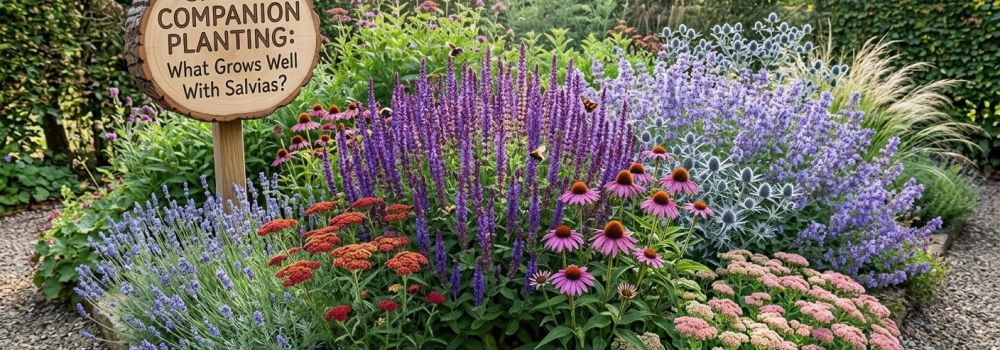
Both prairie natives, both love sun and free-draining soil. The key is the contrast in form: salvia spikes are vertical and dense; echinacea heads are horizontal and open. Together they create a rhythm across a border that draws the eye without either plant dominating.
Best combinations
Purple nemorosa salvias with white or pale pink echinacea — a classic cool palette
Deep cerise microphylla with Echinacea ‘Magnus’ (magenta-pink) — warmer, more saturated
Blue guaranitica with orange or warm-toned echinacea — high contrast, late summer drama
Verbena bonariensis — Airy Height
The see-through plant that works in almost every situation
Tall, wiry stems and small purple flowerheads sit above most salvias without blocking them — creating layers of colour rather than competition. It self-seeds freely, finding its own way into gaps in a salvia planting and creating naturalistic drifts that look entirely deliberate. The bees love it too. Plant behind or through compact nemorosa salvias, or alongside taller guaranitica varieties where its wiry stems complement the structural height.
Agapanthus — Late Summer Drama
A useful gap-filler in the summer-to-autumn transition
Agapanthus flowers slightly later than most nemorosa salvias. The drumstick flowerheads on tall stems create a completely different shape to salvia spikes and work particularly well with blue and purple salvias. Hardy varieties like ‘Headbourne Hybrids’ can stay in the ground year-round in most UK gardens.
Alliums & Spring Bulbs — Filling the Gap
Covering the bare ground before salvias get going
Most salvias don’t get going until late May or June, leaving bare ground through April and early May. Plant alliums, tulips or camassia through salvia plantings in autumn — they’ll flower through the gap, and by the time they fade the salvias are growing strongly enough to cover the dying foliage.
Best bulb companions
Allium ‘Purple Sensation’ — deep violet spheres that echo the colour of purple nemorosa, flowering simultaneously
Allium hollandicum ‘Purple Rain’ — slightly more open than Purple Sensation, equally effective
Camassia leichtlinii — tall spikes of starry blue flowers in late spring, particularly good with early nemorosa varieties
Roses — A Classic Combination
A long-established partnership for good reason
Salvias and roses have a long history together — both love sun, both perform in summer, and the soft texture of salvia flower spikes contrasts beautifully with bold rose blooms. Use compact nemorosa salvias as underplanting beneath shrub or English roses. ‘Caradonna’ beneath a deep pink or red rose is a combination that appears in some of the great English gardens — the deep purple and rich pink work together in a way that feels entirely natural.
What to Avoid
-
✕
Moisture-loving plants — hostas, astilbes and ligularias need far more water than salvias. There’s no growing regime that suits both well.
-
✕
Aggressive spreaders — mint, some geraniums and certain grasses can overwhelm compact salvia varieties before they establish.
-
✕
Shade from large shrubs or trees — salvias in shade produce elongated, floppy growth and significantly fewer flowers.
Shop Plants for a Salvia Combination Border
Browse our full range at Middleton Nurseries — all grown at our Staffordshire nursery and ready to plant together.
Frequently Asked Questions
What are the best companion plants for salvias?
Ornamental grasses are the single best companion for salvias — they share the same growing preferences and provide a beautiful visual contrast to salvia’s upright spikes. Echinacea, verbena bonariensis, agapanthus and alliums all work exceptionally well alongside salvias in UK borders.
Can I plant salvias with roses?
Yes — salvias and roses are a classic combination. Compact nemorosa varieties like ‘Caradonna’ work beautifully as underplanting beneath shrub or English roses. Make sure the salvia gets at least six hours of direct sun, so position it on the sunny side of the rose rather than directly beneath its canopy.
What should I not plant with salvias?
Avoid moisture-loving plants like hostas, astilbes and ligularias — their growing requirements are too different from salvias for both to thrive together. Also avoid aggressive spreaders that may overwhelm young salvias, and don’t plant salvias in the shade of large shrubs or trees where they’ll become leggy and flower poorly.
Do salvias grow well with grasses?
Exceptionally well. Salvias and ornamental grasses share almost identical growing conditions — full sun and free-draining soil — and the visual contrast between salvia spikes and flowing grass stems is one of the most effective combinations in naturalistic planting design. Stipa tenuissima and Pennisetum ‘Hameln’ are two of the best choices.
Can I plant bulbs with salvias?
es, and it’s highly recommended. Spring bulbs planted through salvia beds flower during the gap in spring before salvias get going, and by the time bulb foliage starts to die back the salvias are growing strongly enough to cover it. Alliums are particularly effective — many flower at the same time as early nemorosa varieties and the spherical heads contrast beautifully with salvia spikes.
What grows well with salvia nemorosa specifically?
Salvia nemorosa combines particularly well with Stipa tenuissima, alliums, echinacea in white or pale pink, and English roses. For a naturalistic meadow-style planting, try nemorosa with Pennisetum ‘Hameln’ and verbena bonariensis — this combination appears in many award-winning show gardens for good reason.