
TL;DR
- Salvias fall into three groups: fully hardy, semi-hardy and tender
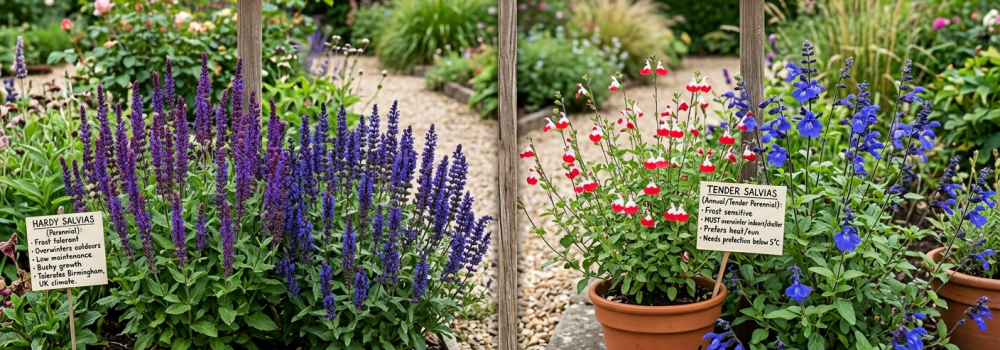
- Fully hardy salvias (nemorosa, sylvestris) stay in the ground year-round in most of the UK
- Semi-hardy types (microphylla, greggii) need frost protection but are borderline in sheltered gardens
- Tender salvias (guaranitica, patens, uliginosa) need lifting, cuttings or a frost-free space over winter
- The right choice depends on your time, your climate and how much winter effort you want to put in
Introduction
Hardy vs Tender Salvias: One of the most common questions we get at Middleton Nurseries is some version of “will it survive winter?” It’s the right question to ask — and the answer depends entirely on which group of salvias you’re looking at.
Hardy, semi-hardy and tender aren’t just gardening jargon. They’re a practical guide to how much work a salvia will ask of you once the growing season ends. Get the match right between your garden, your climate and your expectations, and salvias are among the most rewarding plants you can grow. Get it wrong and you’ll be replacing expensive plants every spring.
This guide cuts through the confusion and gives you a clear framework for choosing.
Quick Facts Hardy vs Tender Salvias
| Fully hardy | Survives UK winters in the ground without protection (RHS H5–H7) |
| Semi-hardy | Borderline hardy — survives mild winters, needs protection in cold areas (RHS H3–H4) |
| Tender | Will not survive frost — needs lifting, cuttings or overwintering under cover (RHS H1–H2) |
| Key factor | Your location matters — a sheltered London garden is very different to an exposed Derbyshire plot |
| RHS rating | Regular but never waterlogged — check drainage holes are clear |
| Hardiness | Check the RHS Plant Finder for the hardiness rating of any specific variety |
The Three Groups Explained
Salvia nemorosa & sylvestris
RHS H5 and above — survives UK winters without protection
These are the set-and-forget salvias. Plant them, cut them back in spring, and they’ll return reliably year after year without any intervention. They’re the backbone of any permanent salvia planting.
Compact, upright perennials that flower in early summer and again after cutting back. Varieties like ‘Caradonna’, ‘Mainacht’ and ‘Ostfriesland’ are fully hardy throughout the UK, including Scotland and exposed northern gardens. Best choice for exposed sites, heavy clay soils and gardens that regularly see hard frosts.
Best varieties to consider
Salvia nemorosa ‘Caradonna’ — deep purple spikes, very upright habit, RHS Award of Garden Merit ↗
Salvia nemorosa ‘Mainacht’ — rich indigo, one of the earliest to flower
Salvia × sylvestris ‘Blaukonigin’ — soft blue, spreads gently to form a clump
Salvia microphylla & greggii
RHS H3–H4 — borderline hardy, needs protection in cold areas
The largest and arguably most exciting group — and the one that causes the most confusion. Semi-hardy salvias will survive winter in many UK gardens but aren’t guaranteed everywhere.
In a sheltered south-facing London or West Country garden they’ll come through winter with just a mulch. In a colder, more exposed northern garden they’ll need more help — a heavy mulch, fleece over the crown, or pot culture so you can move them under cover.
The reward is significant. These are the longest-flowering salvias available — many bloom from May right through to November, producing a season of colour that fully hardy types simply can’t match.
Best varieties to consider
Salvia microphylla ‘Hot Lips’ — iconic white and red bicolour, flowers for months
Salvia microphylla ‘Jezebel’ — deep cerise pink, compact and bushy
Salvia greggii ‘Cerro Potosi’ — soft magenta, particularly good in pots
Salvia guaranitica, patens & uliginosa
RHS H1–H2 — will not survive frost, needs overwintering under cover
The showstoppers — dramatic, often tall, with some of the most vivid blues and purples in the salvia world. They won’t survive frost outdoors, but they’re not difficult to overwinter if you know what you’re doing.
You have three options: take cuttings in late summer and root them on a frost-free windowsill, lift the tubers (patens in particular forms useful tubers), or move container-grown plants into a greenhouse, conservatory or unheated porch before the first frost.
Best varieties to consider
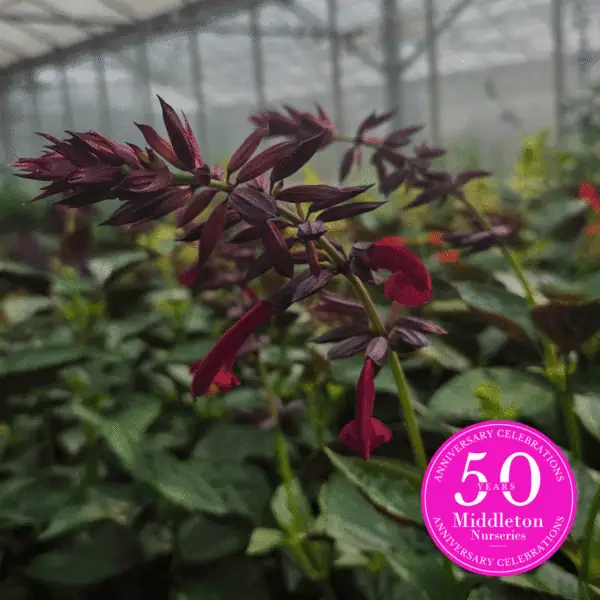
Salvia guaranitica ‘Black and Blue’ — deep navy calyces, electric blue flowers, very dramatic
Salvia patens ‘Cambridge Blue’ — pale sky blue, one of the purest blues in the summer garden
Salvia uliginosa — tall airy stems, works brilliantly with ornamental grasses
How to Choose the Right Group for Your Garden
The decision comes down to three honest questions.
Where in the UK are you?
If you're in the south, west or a sheltered urban garden, semi-hardy salvias are very likely to overwinter with minimal help. If you're in the north, Scotland, or an exposed or elevated site, stick to fully hardy types in the ground and use pots for anything tender or semi-hardy so you can move them.
How much winter effort do you want?
Be honest with yourself. If you're not going to remember to take cuttings in September or move pots into the garage in November, choose fully hardy varieties and avoid the losses. Semi-hardy and tender salvias are worth the effort — but they do require it.
What are you planting them in?
Pots give you flexibility regardless of hardiness group — you can always move a pot. If you're planting directly into beds and borders, hardiness becomes more important. A semi-hardy salvia in a border in a cold garden is a gamble; the same plant in a pot is manageable.
Our Recommendations by Garden Type
Small sheltered patio or urban garden
Semi-hardy microphylla and greggii in pots — maximum colour, manageable overwinter in a porch or garage.
Large mixed border — south or west
A mix of fully hardy nemorosa for reliability and semi-hardy microphylla for long-season colour. Add a guaranitica for height and drama.
Exposed or northern garden
Stick to fully hardy nemorosa and sylvestris. They'll perform brilliantly and come back every year without any fuss.
Greenhouse or conservatory access
You can grow anything. Go for tender guaranitica, patens and uliginosa — genuinely spectacular plants most gardeners never try.
Shop by Hardiness Group
Browse our full salvia range at Middleton Nurseries — every variety is clearly labelled with its hardiness rating so you can choose with confidence.
Frequently Asked Questions
What is the difference between hardy and tender salvias?
Hardy salvias survive UK winters outdoors without protection and return reliably each year. Tender salvias cannot tolerate frost and need to be overwintered under cover — either as cuttings, lifted tubers, or by moving the whole plant indoors. Semi-hardy salvias sit between the two: they survive mild winters in sheltered spots but need protection in colder or more exposed gardens.
Which salvias are fully hardy in the UK?
Salvia nemorosa and Salvia sylvestris varieties are the most reliably hardy salvias for UK gardens, surviving winters throughout most of the country including Scotland. Look for varieties with an RHS hardiness rating of H5 or above for guaranteed year-round outdoor performance.
Can Salvia microphylla survive winter in the UK?
In many UK gardens, yes — particularly in sheltered, south-facing or urban plots. Salvia microphylla is rated RHS H3–H4, which means it will survive mild winters with some protection but may be cut back or lost in a hard frost. In colder or more exposed gardens, overwintering cuttings or moving pot-grown plants under cover is the safest approach.
Do I need to dig up tender salvias in autumn?
Not always. Salvia patens forms tubers that can be lifted and stored like dahlias. Salvia guaranitica can be cut back hard and the crown protected with a thick mulch in milder areas. In most UK gardens though, taking cuttings in late summer is the most reliable method — it also gives you more plants for the following year.
What is the hardiest salvia for a cold UK garden?
Salvia nemorosa varieties are the best choice for cold, exposed or northern gardens. ‘Caradonna’ and ‘Mainacht’ are particularly tough and have performed reliably in gardens across the UK including Scotland. Both hold an RHS Award of Garden Merit.
Is it worth growing tender salvias if I don't have a greenhouse?
Yes — a frost-free windowsill, porch, garage or conservatory is enough to overwinter cuttings of most tender salvias. Salvia guaranitica cuttings root easily in September and can be kept on a bright windowsill through winter. You don’t need a greenhouse, just somewhere that won’t drop below freezing.