

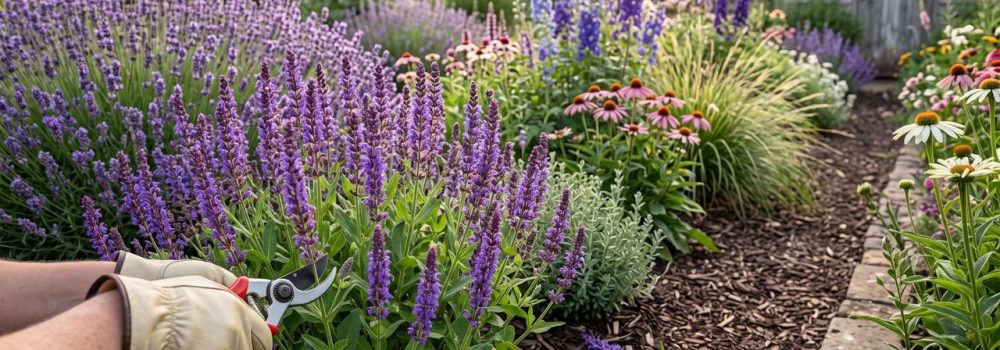
Salvia pruning UK is one of those topics where a single piece of bad advice — cut all salvias back hard in autumn — accounts for the majority of winter salvia losses in UK gardens. There are three meaningfully different salvia pruning groups in the UK, and treating them all the same is the fastest route to dead plants. Understanding which group your salvia belongs to takes two minutes and saves you a season.
Hardy nemorosa varieties should be cut back in spring once new growth appears at the base — never in autumn. The Hampton Chop (cutting back by half in late June or early July) reliably produces a second flush of flowers in August and September. Shrubby microphylla and jamensis need the lighter Hampton Hack in July, not the full Hampton Chop. Tender guaranitica and patens should be cut back by a third before moving under cover in autumn.
TL;DR — Quick Summary
- Salvia pruning UK requires understanding three distinct groups — hardy herbaceous, shrubby semi-hardy and tender — each with a completely different approach
- Never cut back any salvia group in autumn — old stems protect the crown from frost and wet
- Hardy nemorosa: cut back in spring; Hampton Chop (cut by half) in late June for a second flush
- Shrubby microphylla and jamensis: spring cut back + Hampton Hack (light trim) in July; never the Hampton Chop
- Tender guaranitica and patens: cut back by a third before moving under cover; remove dead growth in spring
Quick Facts
| Biggest mistake | Applying one approach to all salvias — different groups need completely different pruning |
| Group 1 (nemorosa) | Cut back spring; Hampton Chop late June for second flush |
| Group 2 (microphylla/jamensis) | Cut back spring; light Hampton Hack July; deadhead throughout |
| Group 3 (tender) | Cut back third before overwintering; remove dead growth spring |
| When NOT to prune | Never in autumn — stems protect the crown |
| Hampton Chop | Hardy nemorosa only — never on shrubby or tender types |
| Hampton Hack | Light summer trim for shrubby microphylla and jamensis |
| Key tool | Sharp, clean secateurs — clean blades reduce disease risk |
Salvia pruning UK is one of those topics where a single piece of bad advice — “cut all salvias back hard in autumn” — accounts for the majority of winter salvia losses in UK gardens. There are three meaningfully different pruning groups, and treating them all the same is the fastest route to dead plants. Understanding which group your salvia belongs to takes two minutes and saves you a season.
Hardy Herbaceous Salvias — nemorosa, sylvestris
These die back to ground level each winter. The key rule is to leave old foliage standing through winter rather than cutting it back in autumn — the stems protect the crown from frost and wet. Cut back in spring once new growth appears at the base, typically February or March. A light tidy is all that’s needed. After the first flush in early summer, the Hampton Chop — cutting back by half in late June or early July — reliably produces a second flush in August and September. See our nemorosa varieties guide for timing detail.
✓ Do
- ✓Leave stems on through winter for crown protection
- ✓Cut back in spring once new growth visible at base
- ✓Hampton Chop (cut by half) in late June for second flush
✗ Don’t
- ✗Don’t cut back in autumn — exposes crown to frost
- ✗Don’t cut to the ground in spring before shoots appear
Shrubby Semi-Hardy Salvias — microphylla, greggii, jamensis
These are shrubby evergreens that don’t die back completely. They need a different approach to the herbaceous nemorosa group — and a different summer intervention too. Never apply the Hampton Chop to these; instead use the Hampton Hack in early July — a lighter trim rather than a hard cutback. Cut back in spring once you can see new growth emerging, removing old and dead wood back to healthy shoots. Deadhead every two to three weeks through the season. See our microphylla care guide for full detail.
✓ Do
- ✓Cut back in spring (April–May) once new growth visible
- ✓Hampton Hack (light trim) in early July to stimulate new flowering
- ✓Deadhead every 2–3 weeks through the growing season
- ✓Leave stems on through winter for frost protection
✗ Don’t
- ✗Don’t apply the Hampton Chop — removes all developing buds
- ✗Don’t cut back hard in autumn
- ✗Don’t cut into old woody stems without green growth visible
Tender Salvias — guaranitica, patens, uliginosa, involucrata
Tender salvias don’t have a standard annual pruning regime in the same way as the other groups — because they need overwintering intervention before pruning is relevant. Cut back by a third before moving under cover in autumn; this reduces demand on the root system and makes the plant easier to manage in a confined space. In spring, once new growth appears, remove any dead or damaged stems. See our overwintering salvias guide and cuttings guide for the complete winter process.
✓ Do
- ✓Cut back by a third before moving under cover in autumn
- ✓Remove dead and damaged stems in spring once new growth appears
- ✓Take cuttings in August as the primary overwintering method
✗ Don’t
- ✗Don’t leave tender salvias outdoors without protection — they will not survive frost
- ✗Don’t cut back hard in autumn before moving under cover
⚠ The most common salvia pruning mistake: Applying a one-size-fits-all approach. Cutting a ‘Hot Lips’ or ‘Caradonna’ back hard in autumn the same way will kill one of them. Always identify which group your salvia belongs to before reaching for the secateurs.
Shop salvias by type
Understanding salvia pruning UK starts with knowing which group your plant belongs to. Browse our full range at Middleton Nurseries — every variety is labelled with its type, hardiness and care requirements.
Browse all salvias →