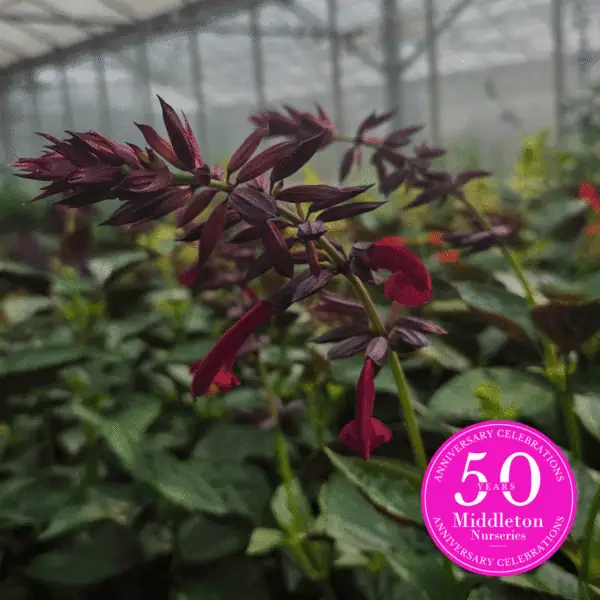


Salvia guaranitica UK is one of the most architecturally dramatic plants you can grow in a late-summer border — tall stems reaching 100–150cm, deep tubular flowers in blues and purples, and an exceptional flowering season from July right through to the first frosts. This late-season performance is what makes salvia guaranitica UK so valuable when most summer plants are fading and the border needs something to carry it into autumn.
The most important thing to understand about growing salvia guaranitica UK is that it is tender — rated RHS H2 — and will not survive frost outdoors in most UK gardens. Despite being occasionally sold as a hardy perennial, salvia guaranitica UK needs reliable overwintering protection every year. The safest method is to take semi-ripe cuttings in August, which root quickly and overwinter easily on a frost-free windowsill. The long tubular flowers are specifically designed for long-tongued bumblebees, making this one of the most valuable late-season pollinator plants available for UK gardens.
TL;DR — Quick Summary
- Salvia guaranitica UK is one of the most dramatic late-season salvias you can grow — tall, architectural and exceptional for pollinators in August and September
- Tender (RHS H2) — needs overwintering under cover or from cuttings; not reliably hardy outdoors in the UK
- Flowers from July through to the first frosts, filling the border gap when most summer plants are fading
- The long tubular flowers are specifically designed for long-tongued bumblebees — particularly Bombus hortorum
- Varieties range from deep navy blue (‘Black and Blue’) to rare soft sky-blue (‘Argentine Skies’) — exclusively at Middleton
Quick Facts
| Hardiness | RHS H2 — tender; will not survive frost outdoors |
| Origin | South America — Brazil, Paraguay, Argentina |
| Position | Full sun; sheltered from cold winds |
| Soil | Free-draining; tolerates most soils if drainage is good |
| Flowering season | July to first frosts — peak August to October |
| Height | 100–150cm depending on variety and season |
| Key care | Overwinter from cuttings or under cover; cut back by a third before moving |
| Pollinators | Outstanding — specifically valued by long-tongued bumblebees |
The Best Salvia guaranitica Varieties
Salvia guaranitica ‘Black and Blue’
The most widely grown guaranitica — deep navy calyces with rich blue flowers creating an almost iridescent jewel-like effect in late summer light. Bold and upright at 100–120cm, flowering July to frost. The contrast between the near-black calyx and electric blue flower is unlike anything else in the summer border. One of the best late-season plants for pollinators. See our overwintering guide for winter care.
Salvia guaranitica ‘Argentine Skies’
Our Chelsea 2026 introduction — a rare, soft sky-blue guaranitica unlike anything else available in the UK. Genuinely unusual colour for a species that tends towards deep navy and cobalt. Clear pale blue flowers on upright stems reaching 100–120cm; cooler, airier and particularly beautiful in late summer light. The most-discussed variety at our 2026 Chelsea exhibit.
Buy Argentine Skies →Salvia guaranitica ‘Blue Enigma’
Pure, unfading clear blue — no violet tone, no purple tinge. Slightly more compact than Black and Blue at around 90–100cm with a reputation for reliable performance even in less-than-ideal UK conditions. One of the best for gardens where full shelter from cold winds can’t always be guaranteed.
Salvia ‘Amistad’
Large rich purple flowers on very vigorous plants reaching 120cm+, flowering from late May right through to October — one of the longest seasons of any salvia. Classified as a guaranitica hybrid for practical purposes. Often oversold as hardy; treat as tender in most UK gardens. Take cuttings in August for reliable overwintering. See our guide to salvias for pollinators for more on its exceptional season-long value.
Growing Salvia guaranitica UK
Salvia guaranitica UK growing requires full sun, a sheltered position and free-draining soil. Plant against a south or west-facing wall where possible for additional warmth. Improve drainage before planting if your soil is heavy — incorporate sharp grit or perlite. The RHS tender salvia guide confirms guaranitica performs best with warmth and shelter.
☀ Soil & Position
Full sun, sheltered from cold winds. Free-draining soil essential — improve clay with sharp grit before planting. Container growing gives you the advantage of moving to the best position through the season and under cover in autumn. Use peat-free compost with 20% grit.
💧 Feeding & Watering
Unlike drought-tolerant nemorosa, guaranitica benefits from consistent moisture and regular feeding. Feed fortnightly with high-potash liquid fertiliser May to September. Water regularly, particularly in the first season and for container-grown plants in hot weather.
🌿 Pollinators
Outstanding late-season pollinator value. The long tubular flowers are specifically designed for the garden bumblebee Bombus hortorum, whose tongue length perfectly matches the flower tube. Provides rich nectar in August–October when few other plants are flowering. See our pollinator guide.
🌿 Staking
Tall varieties — particularly Amistad at 120cm+ — benefit from staking in exposed positions. Place a grow-through support in spring before growth becomes top-heavy. In sheltered positions or against a wall, staking is usually unnecessary.
Overwintering Salvia guaranitica UK
Salvia guaranitica will not survive frost outdoors — unlike semi-hardy microphylla which often comes through with a mulch in southern gardens, guaranitica needs reliable frost protection every winter. You have three options:
Take Cuttings in August Most reliable
Semi-ripe cuttings taken in August root quickly and produce compact plants easy to overwinter on a frost-free windowsill. Far more manageable than large established plants. Full process in our salvia cuttings guide.
Move Whole Plant Under Cover
Move pot-grown plants into a frost-free space before the first frost — garage, unheated greenhouse, conservatory or enclosed porch. Cut back by a third before moving. Keep barely moist through winter. Move outside once frost risk passes in late spring.
Mulch in Situ Mild sheltered gardens only
In the most sheltered south-facing gardens in the south and west, Amistad and occasionally Black and Blue may survive a mild winter with a very generous mulch. Not reliable — a hard winter will finish them. See our full overwintering guide.
Ready to grow salvia guaranitica UK?
Browse our full guaranitica range at Middleton Nurseries — grown at our Staffordshire nursery using peat-free compost and dispatched nationwide.
Browse Salvia guaranitica →